Secondary and tertiary crushing
reduces pre-crushed stone before screening or further processing.

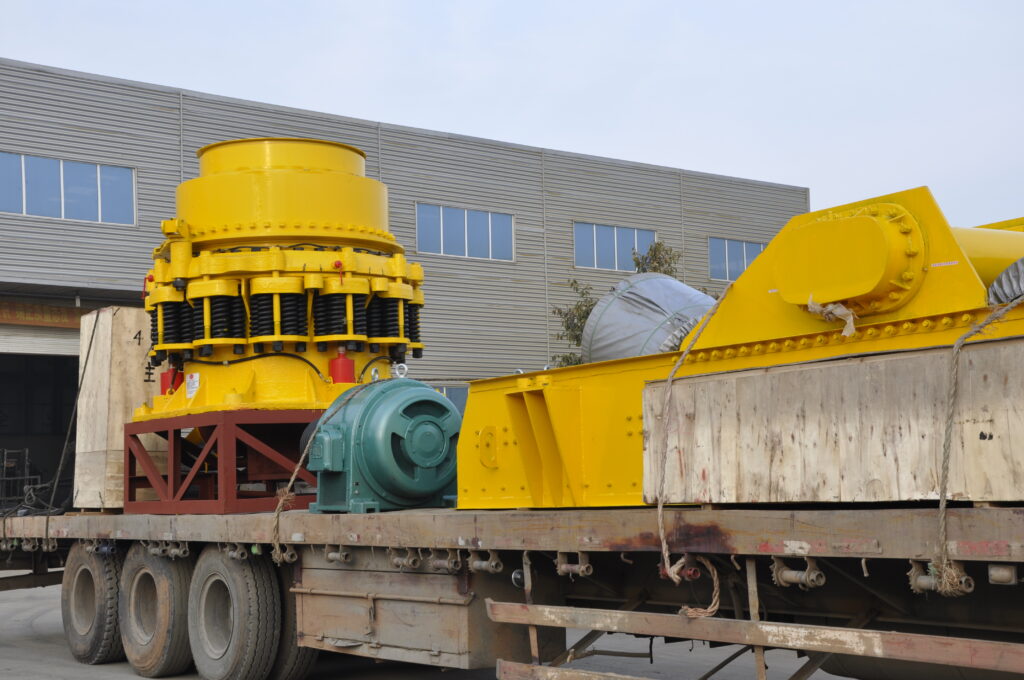
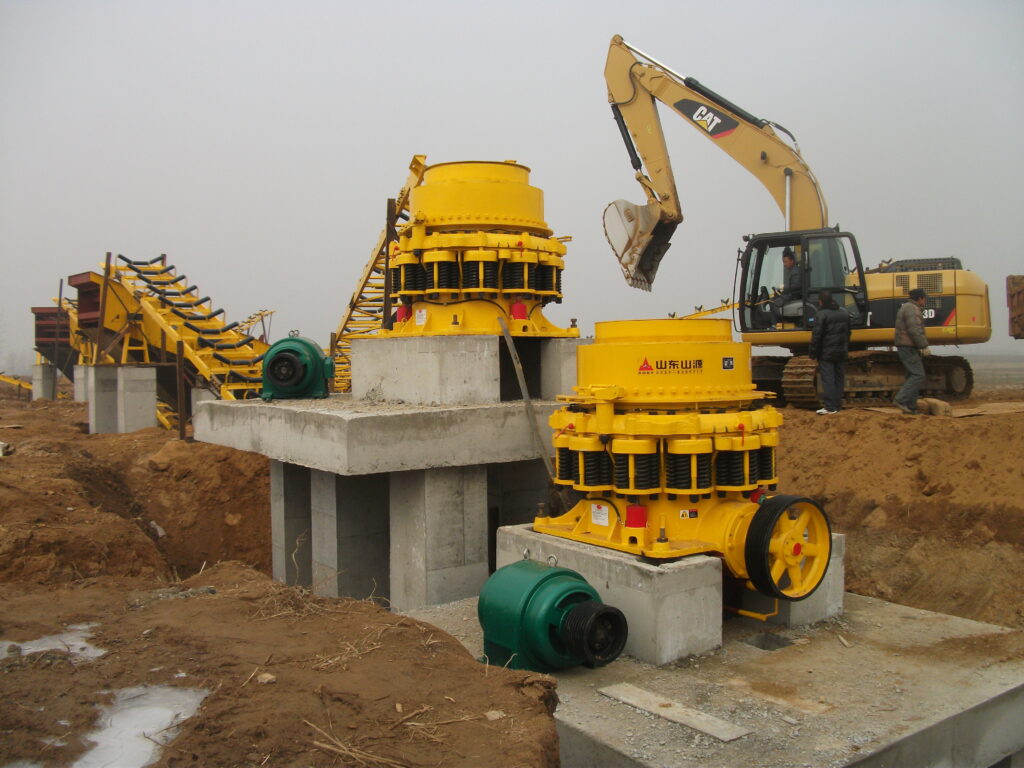
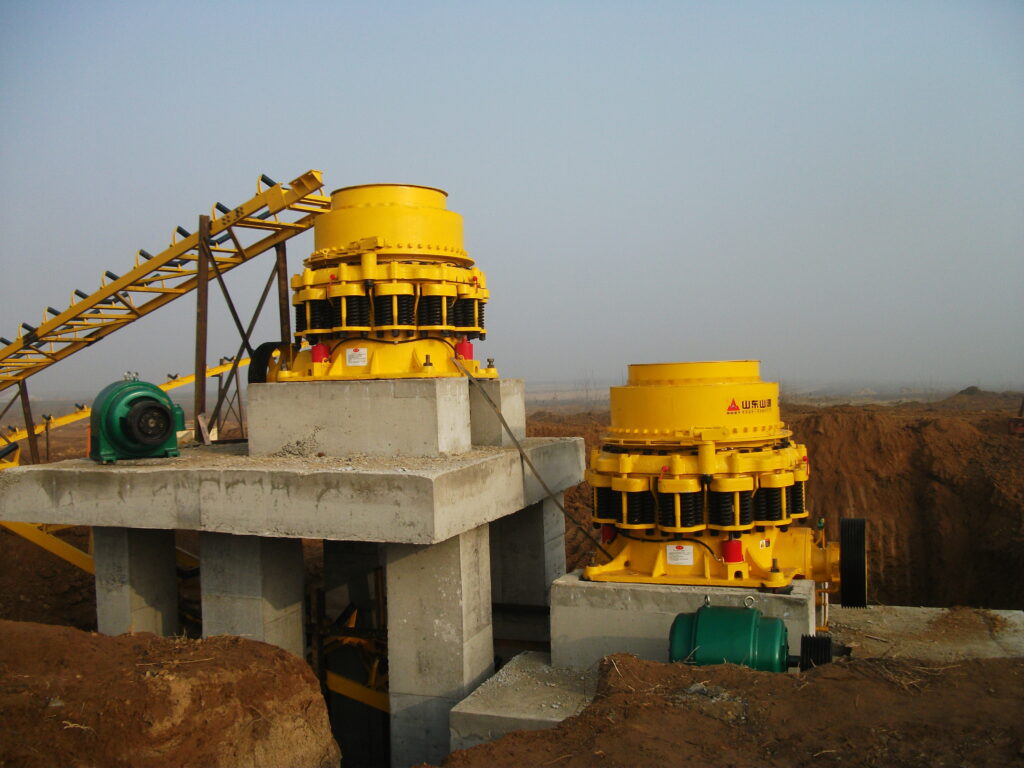
PY series cone crusher for secondary and tertiary stone crushing. Compare model and crushing chamber specifications to match your feed size, capacity and output requirements.
Tell us your material, feed size and target capacity for model selection.
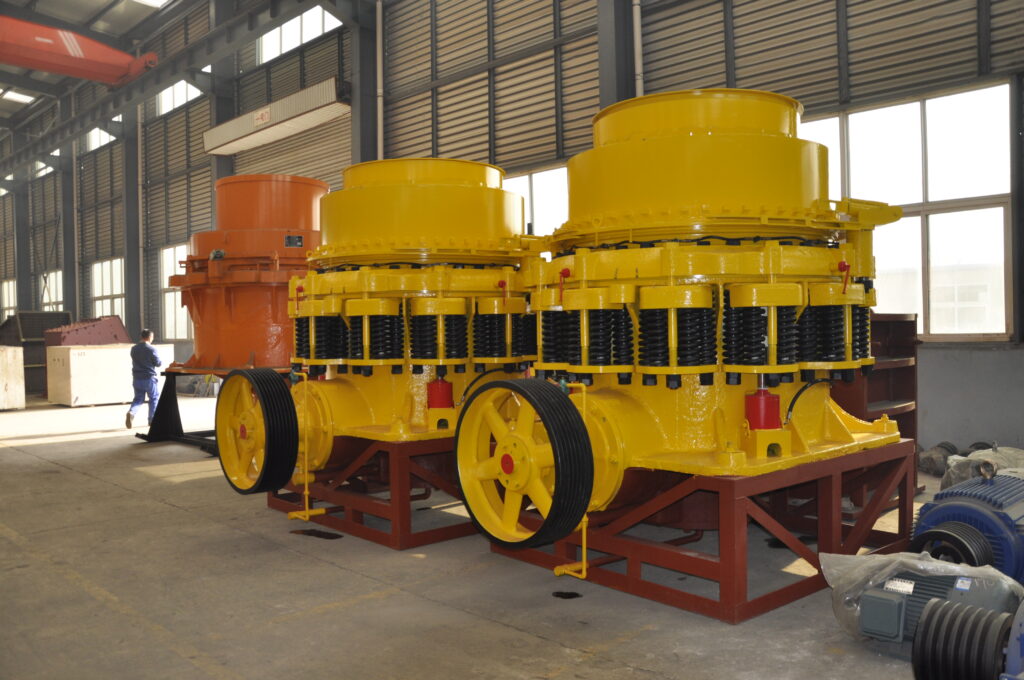
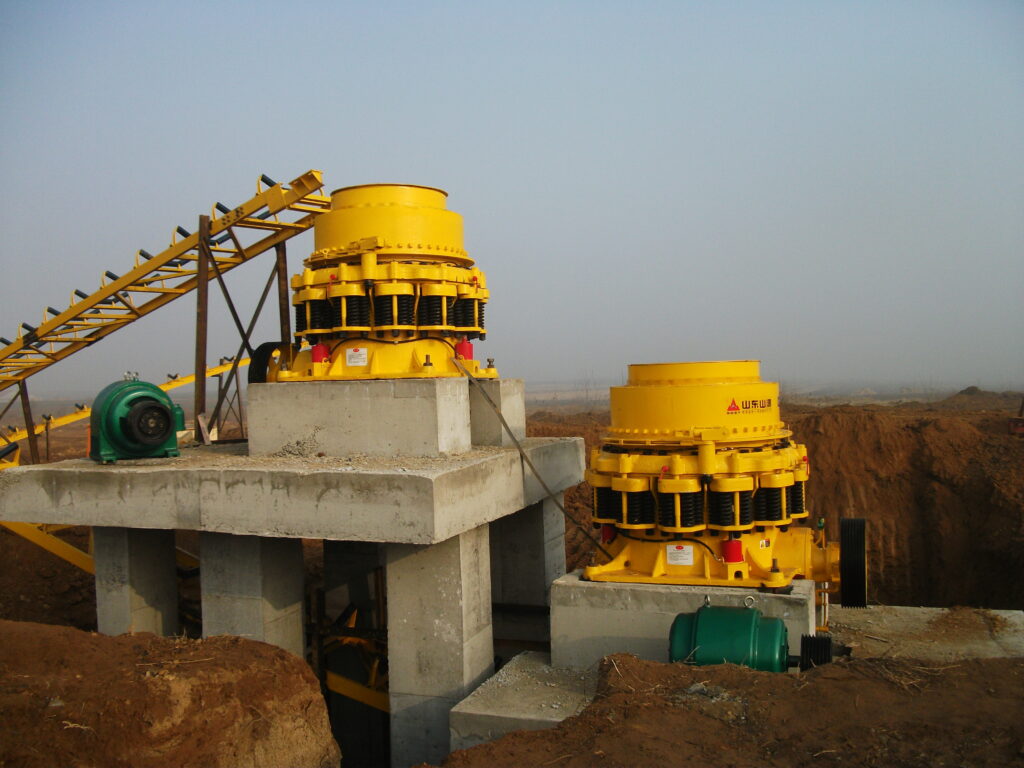
The PY series cone crusher is an option for secondary and tertiary crushing in quarry and aggregate production lines, particularly when processing hard or abrasive stone such as granite, basalt and river stone.
Consider this series when the feed has already been reduced by an upstream crusher and further size reduction is required before screening. Select the model and crushing chamber according to the feed size, required throughput and discharge requirements. For plant upgrades, assess the existing feeder, conveyors and screen to ensure the additional crusher fits the production line.
The PY series cone crusher is used for secondary and tertiary crushing in quarrying, stone processing and aggregate production. It processes suitably sized stone from an upstream crusher before screening or further size reduction.
Potential materials include granite, basalt and river stone. Suitability depends on material hardness, abrasiveness, moisture and feed size. Select the model and crushing chamber according to the required capacity and discharge setting. Screening and recirculation of oversized material may be needed to obtain the specified final aggregate sizes.
The motor transmits power through the drive system to the eccentric mechanism, causing the mantle to move eccentrically within the stationary concave. As the gap between the two crushing surfaces narrows, material is compressed and broken.
As the gap opens, material moves down through the crushing chamber under gravity. This process repeats until the material passes through the discharge opening. The crushing chamber, discharge setting, feed characteristics and operating conditions influence the resulting particle size distribution and capacity.
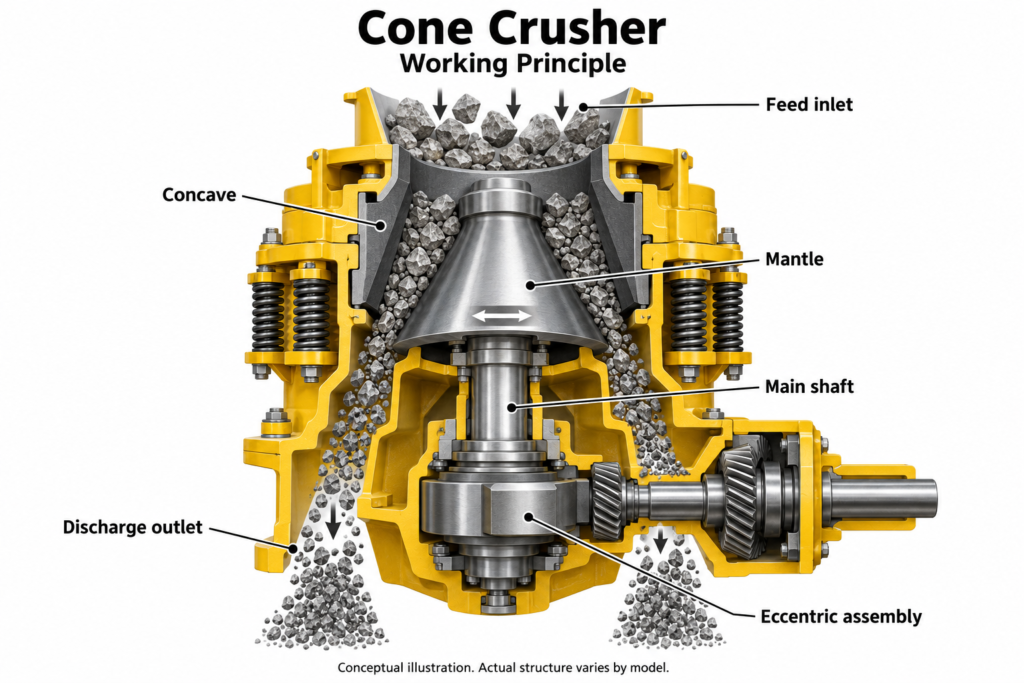
reduces pre-crushed stone before screening or further processing.
breaks material between the moving mantle and stationary concave.
match the available crushing chamber to the feed size and production requirements.
allows adjustment within the selected model's specified operating range.
mantle and concave wear should be monitored and replacements planned.
| Model | Crushing head diameter(mm) | Cavity | Feed opening(mm) | Output adjustment(mm) | Capacity(t/h) | Power(kW) | Weight(t) | Overall dimensions(L×W×H, mm) |
|---|---|---|---|---|---|---|---|---|
| PYB900 | 900 | Fine (标准型) | 115 | 15-50 | 50-90 | 55 | 11.2 | 2692×1640×2350 |
| PYZ900 | 900 | Medium (中型) | 60 | 5-20 | 20-65 | 55 | 11.2 | 2692×1640×2350 |
| PYD900 | 900 | Coarse (短头型) | 50 | 3-13 | 15-50 | 55 | 11.3 | 2692×1640×2350 |
| PYB1200 | 1200 | Fine (标准型) | 145 | 20-50 | 110-168 | 110 | 24.7 | 2790×1878×2844 |
| PYZ1200 | 1200 | Medium (中型) | 100 | 8-25 | 42-135 | 110 | 25 | 2790×1878×2844 |
| PYD1200 | 1200 | Coarse (短头型) | 50 | 3-15 | 18-105 | 110 | 25.3 | 2790×1878×2844 |
| PYB1750 | 1750 | Fine (标准型) | 215 | 25-60 | 280-480 | 155 | 50.3 | 3910×2894×3809 |
| PYZ1750 | 1750 | Medium (中型) | 185 | 10-30 | 115-320 | 155 | 50.3 | 3910×2894×3809 |
| PYD1750 | 1750 | Coarse (短头型) | 85 | 5-13 | 75-230 | 155 | 50.2 | 3910×2894×3809 |
| PYB2200 | 2200 | Fine (标准型) | 300 | 30-60 | 590-1000 | 280 | 83 | 4622×3032×4470 |
| PYZ2200 | 2200 | Medium (中型) | 230 | 10-30 | 200-580 | 280 | 83 | 4622×3032×4470 |
| PYD2200 | 2200 | Coarse (短头型) | 100 | 5-15 | 120-340 | 280 | 83 | 4622×3032×4470 |
Specifications are for reference only. Performance depends on material properties and operating conditions. Confirm the selected model and configuration with LBZG before ordering.
Ask about a suitable model →provide the rock type, hardness, abrasiveness, moisture and fines content to assess suitability and wear requirements.
compare the largest incoming stones and feed size distribution with the limits of the selected model and crushing chamber.
match the chamber to the intended crushing stage and required size reduction. Confirm the available configuration against the PY catalogue.
provide the target tonnes per hour and final aggregate sizes. Assess capacity at the intended discharge setting and include screening requirements.
confirm the upstream crusher, feeding arrangement, conveyors, screen, electrical supply, foundation requirements and maintenance space.
discuss mantle and concave specifications, lubrication requirements and replacement access. Include spare parts and maintenance in the operating budget.
Interested in PY Series Cone Crusher? Share your project requirements with our team.
Tell us your material, target capacity and required output sizes so we can discuss the equipment and quotation scope.
Before each shift, check lubricant levels, visible leaks, fasteners, drive belts, guards and the condition of accessible components according to the equipment manual. Inspect the mantle and concave for wear at the intervals specified for the selected model.
During operation, maintain controlled, evenly distributed feeding within the manufacturer's requirements. Monitor lubrication-system readings, bearing temperature, noise and vibration. Stop the equipment and investigate abnormal conditions before restarting.
Follow the model-specific manual for lubricant selection, service intervals, discharge adjustment and liner replacement. Stop the crusher, isolate and lock out all energy sources, and release stored energy as instructed before maintenance. Never enter or reach into the crushing chamber while the equipment is running.
Discuss equipment selection and your project requirements with our team.
Confirm installation responsibilities and available guidance for the agreed equipment scope.
Share your equipment model and part requirements to discuss suitable replacements.
Send LBZG your material type, maximum feed size, required capacity, target aggregate sizes and project location to discuss model selection and quotation requirements. For an existing plant, include details of the upstream crusher, conveyors and screen.
Before ordering, confirm the equipment configuration, scope of supply, technical documentation and recommended spare parts. Discuss installation and commissioning arrangements, operator guidance, warranty terms and after-sales support. Service availability, responsibilities and any additional charges should be confirmed in the quotation and contract.
Share your material, target capacity and required output sizes.